Detecting Liquidation Cascades Before They Hit Your Position: A Methodology
Detect liquidation cascades before they hit your Aave position. Master the three-tier methodology: leading indicators, mid-range warnings, immediate red flags. Includes cascade detection tools.
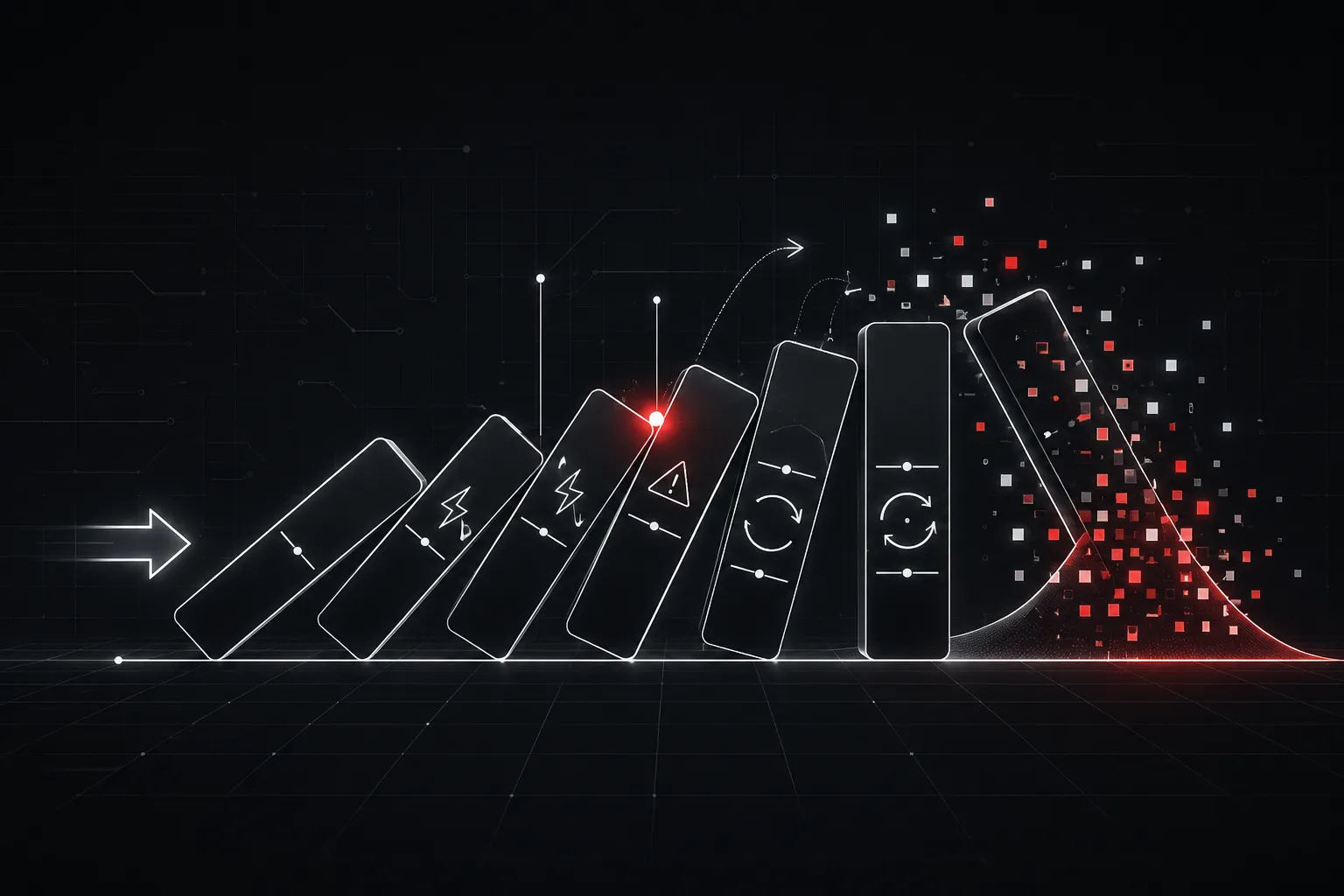
When leveraged DeFi positions unwind, they rarely do so in isolation. A single price shock can trigger a self-reinforcing chain reaction — a liquidation cascade where forced collateral sell-offs depress prices further, activating additional liquidations across interconnected positions. Understanding these cascades and the signals that precede them is not optional for anyone holding borrowed assets.
This article walks through a practical three-tier detection methodology, concrete signals to watch, and specific protection tactics for Aave users.
What Are Liquidation Cascades?
A liquidation cascade is a chain reaction of forced automated asset sell-offs in crypto lending markets, triggered when collateral value drops below LTV (Loan-to-Value) thresholds. Liquidator bots sell seized collateral, depressing prices further and triggering subsequent forced sell-offs.
Three primary conditions trigger cascades:
- Extreme market volatility — prices move sharply enough to compress health factors across many positions simultaneously
- Low liquidity amplifying slippage — when liquidators sell seized assets, the lack of buy-side depth pushes prices down harder
- Oracle manipulation or stale pricing data — if oracle feeds lag behind market prices, safety mechanisms fail to trigger early interventions
Unlike isolated liquidations affecting single positions, cascades affect interconnected positions across the protocol simultaneously. The difference matters because isolated liquidations happen gradually as individual positions slip below thresholds. Cascades happen suddenly when many positions breach their thresholds at once.
How Liquidation Cascades Form
Cascades originate from three structural conditions working in concert.
First: extreme price volatility compressing health factors across many positions. When BTC or ETH drops 15–25% in hours, positions that were comfortably above their liquidation thresholds suddenly approach 1.0.
Second: oracle latency or misconfiguration. Even Chainlink — considered the gold standard for decentralized price feeds — can lag during network congestion or face implementation errors. The March 2026 wstETH incident is instructive: oracle misconfiguration reportedly forced $27M in unwarranted liquidations, highlighting oracle risk even on major assets. For a deeper look at oracle failure modes, see our guide on Chainlink oracle price feeds and DeFi protection.
Third: concentrated collateral exposure. When many positions hold the same asset near identical liquidation thresholds, liquidations in one asset trigger liquidations in others. Forced sales amplify downward price momentum through self-reinforcing liquidation loops.
Network congestion adds a fourth accelerant. Elevated gas fees delay position management — adding collateral or repaying debt takes 15–30 minutes instead of seconds. By then, the cascade has accelerated beyond anyone’s ability to intervene manually.
The October 2025 BTC cascade illustrated all of these mechanisms. $15.3B in BTC positions liquidated in under 40 minutes despite the year’s lowest realized volatility at 30% annualized. Calm surface metrics masked structural fragility.
The Three-Tier Detection Methodology
Practical detection operates across three time horizons with distinct signals and reaction windows.
Leading Indicators: Days Before the Cascade
Monitor aggregate open interest combined with funding rate persistence across exchanges.
Fourteen or more consecutive days of elevated positive funding signals crowded longs vulnerable to a single price shock. Funding persistence at extreme levels indicates overleveraged market structure. When traders sustain persistently elevated funding rates, they’re betting on continued upside without room to absorb reversals.
Low realized volatility regimes can mask maximum systemic fragility. October 2025 had the year’s lowest realized volatility (30%) yet immediately preceded a $15.3B liquidation cascade. Traders had grown complacent precisely when structural fragility was at its peak.
Track this signal across multiple exchanges and timeframes. If funding is elevated on Binance, Bybit, and Deribit simultaneously, the risk is systemic, not localized.
Mid-Range Signals: Hours Before Impact
Watch for volatility regime contradictions where realized volatility is anomalously low while leverage is high.
Basis spread compression from >5% to <3% indicates market maker withdrawal and liquidity contraction. Market makers are the canaries in the coal mine — they pull back when they perceive uncompensated tail risk.
Reduced order book depth at key price levels signals reduced ability to absorb liquidation cascades. If usual buy-side liquidity at $60k BTC disappears while the price approaches $60k, the market lacks shock absorbers.
These signals provide a 2–6 hour window for defensive action if monitoring is active. Add collateral, reduce borrowed amounts, or set up automated protective positions. The window closes when immediate signals fire. Our walkthrough on stress-testing your DeFi portfolio covers concrete steps for this defensive phase.
Immediate Signals: Minutes Before Liquidation
Health factor distributions across the protocol approaching 1.0 for a large share of TVL indicate systemic vulnerability.
Liquidation heatmap density bands concentrating within ±5% of current spot price show imminent pressure points. Brighter yellow-orange bands on heatmaps indicate heavier position concentrations entering high-risk zones. When heatmap density doubles within a 2% price band, liquidations are about to accelerate.
Oracle update lag exceeding 2× normal intervals under network congestion removes the price discovery safety mechanism. If Chainlink updates arrive every 12 seconds normally but lags to 30+ seconds, the system has lost real-time pricing.
Monitor liquidation heatmaps actively when mid-range signals light up. Heatmap tools like Glassnode visualize where leveraged positions face forced liquidation risk in real time.
| Signal Tier | Indicator | Threshold | Window to React |
|---|---|---|---|
| Leading (Days) | Consecutive funding days | 14+ consecutive days positive | 3–7 days |
| Leading (Days) | Realized volatility regime | Anomalously low (20–30% annualized) | 2–5 days |
| Mid-range (Hours) | Basis spread | Compressing from >5% to <3% | 2–6 hours |
| Mid-range (Hours) | Order book depth | Reduced >30% at support levels | 2–6 hours |
| Immediate (Minutes) | Health factor distribution | Concentration near 1.0 | 5–20 minutes |
| Immediate (Minutes) | Heatmap density | Bands within ±5% of spot | 5–20 minutes |
| Immediate (Minutes) | Oracle lag | Exceeding 2× normal interval | 1–10 minutes |
Protecting Your Position on Aave
Health Factor equals (Total Collateral Value × Weighted Average Liquidation Threshold) / Total Borrow Value. Liquidation occurs when Health Factor drops below 1.0.
A health factor above 1.5 provides meaningful buffer against price volatility. Below 1.2, the position warrants immediate action. For the full mechanics of how Aave V3 and V4 size liquidations, see our liquidation risk scores and health factor monitoring guide.
The liquidation mechanics scale with risk. When Health Factor remains above 0.95 (and both collateral and debt sides exceed $2k), up to 50% of debt can be liquidated. When Health Factor drops to 0.95 or below, up to 100% can be liquidated. The protocol allows more drastic haircuts as risk intensifies. The redesigned engine in Aave V4 changes this further by moving to a target-health-factor model with Dutch-auction-style bonuses.
Manage health factor by supplying additional collateral or repaying debt before cascade conditions materialize. Tools like DeFi Saver enable automated repayment triggers, removing manual execution risk during high-gas-fee periods.
Aave’s risk service providers continuously monitor collateral performance. Governance can adjust parameters to respond to market conditions if systemic risk accumulates. Monitor governance proposals during volatile periods — emergency parameter changes signal elevated perception of cascade risk.
Historical Cascades and Lessons
MakerDAO Black Thursday (March 2020) liquidated $8.32M of ETH in minutes due to oracle latency and network congestion. The incident triggered $5.2M in bad debt.
Alpha Homora (February 2021) suffered a $37.5M flash loan attack. The attacker exploited the price oracle, forcing liquidations across interconnected positions. The incident highlighted how cascades don’t require external volatility — they can be triggered by oracle manipulation.
Cream Finance (October 2021) saw $130M exploited due to collateral asset depreciation. The cascade accelerated because collateral assets lost value faster than borrowers could repay.
October 2025’s BTC cascade liquidated $15.3B in under 40 minutes despite the lowest realized volatility of the year. The cascade proved that volatility regimes can mislead.
The March 2026 wstETH incident reportedly forced $27M in unwarranted liquidations due to oracle misconfiguration on a major asset. It reinforced that even protocols with strong governance and audits face oracle risks.
Cascades historically concentrate at price zones with clustered liquidation thresholds. Heatmap concentration at prior cluster points predicts where future risk zones will form.
Monitoring Tools and Setup
DefiLlama provides protocol-level TVL and liquidation volume tracking in real time. It serves as the benchmark DeFi dashboard for most practitioners.
CoinGlass Pro Futures offers visual liquidation heatmaps for BTC/ETH futures with price zones showing highest forced-liquidation density. The visualizations make density patterns immediately apparent.
DeFi Risk Monitor provides real-time Aave V3, Spark, Morpho Blue, and Compound V3 liquidation risk alerts. Wallet-specific health factor tracking with severity-aware notifications via Telegram or Discord — escalating immediately when health factor breaches your thresholds during volatile periods.
Glassnode liquidation heatmaps show pressure points where positions face cascading risk. The data sourced from Hyperliquid (~16% of global BTC perpetual futures open interest (OI)) correlates with actual liquidations across major exchanges.
Set up multiple signal streams rather than relying on any single tool. Combine funding rate aggregators, volatility monitors, oracle lag detectors, and health factor dashboards. The more signal sources feeding into your decisions, the higher your confidence.
Establish automation for collateral top-ups and debt repayment via DeFi Saver or similar keepers when thresholds approach critical levels. Manual reactions during network congestion are unreliable. Automation removes execution risk.
Frequently Asked Questions
What’s the difference between a liquidation and a cascade?
A liquidation affects a single position when its health factor drops below 1.0. A cascade is a self-reinforcing chain reaction affecting many positions simultaneously due to interconnected collateral and leverage.
How much health factor buffer do I really need?
Above 1.5 is safe. 1.2–1.5 requires active monitoring. Below 1.2 is high-risk during volatile periods. The buffer shields you during price movements that would otherwise trigger liquidation.
Can I actually react in time to immediate signals?
Yes, if you’ve automated responses set up via tools like DeFi Saver. Manual reactions during network congestion are unreliable because transaction confirmation times stretch from seconds to minutes.
Why do oracle delays matter if Aave uses Chainlink?
Even Chainlink oracles can lag during network congestion or face misconfiguration (as in the March 2026 wstETH incident). Monitor oracle update intervals actively rather than assuming they’re always instantaneous.
What assets are most cascade-prone?
High-volatility, lower-liquidity collateral and assets with concentrated liquidation thresholds. Check Aave’s risk framework for collateral risk ratings and avoid overconcentration in any single asset.
Sources
- Liquidation Cascade: Causes, Risks, and Prevention — Chainlink
- Risks | Aave Protocol Documentation — Aave
- Health Factor & Liquidations — Aave
- Pressure Points: Liquidation Heatmaps & Market Bias — Glassnode
- The Volatility Framework: How to Read Crypto’s Stress Signals — Amberdata
- How Liquidations Work in DeFi: A Deep Dive — MixBytes
This article is for informational purposes only and does not constitute financial advice. DeFi protocols carry inherent risks including smart contract vulnerabilities, oracle failures, and liquidation cascades. Always conduct your own research before borrowing against collateral.
Get alerts before liquidation — free Telegram & Discord notifications for Aave, Spark, Morpho & Compound.